
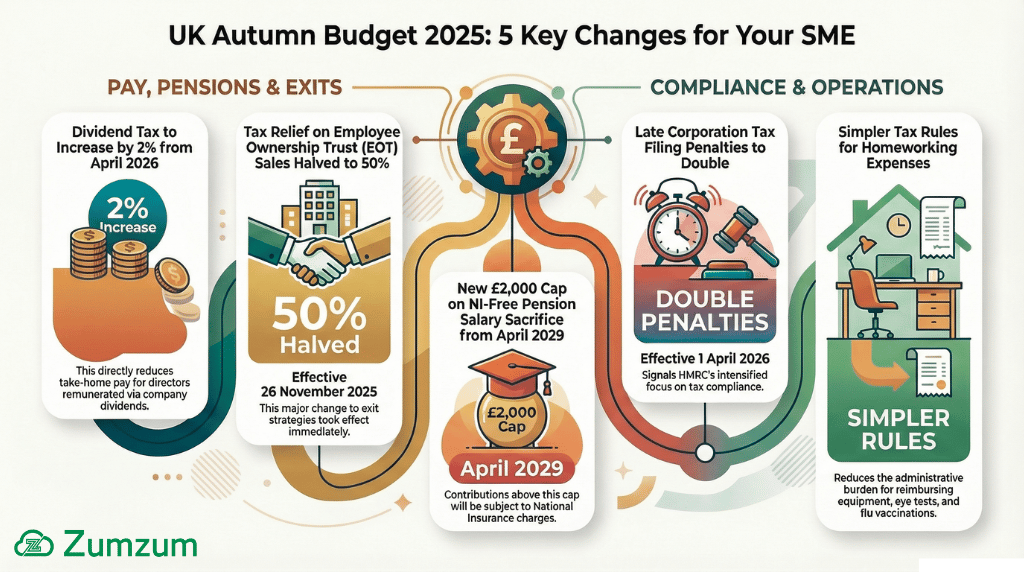
Autumn Budget 2025: The 5 Key Changes Every SME Owner Needs to Know
Every year, the Chancellor’s budget speech unleashes a wave of complex announcements, dense documents, and financial jargon. For busy SME owners, trying to decipher what actually matters for their business can be a significant challenge. It’s easy to get lost in the details and miss the changes that will have a direct and tangible impact on your bottom line, your team, and your future strategy.
In this guide, I’ve cut through that noise. I’ve analyzed the Autumn Budget 2025 and distilled it into the five most critical updates that every UK small and medium-sized business owner needs to understand. From shifts in how you pay yourself to immediate changes in exit strategies, these are the surprising and impactful takeaways you can’t afford to ignore in your financial planning.
1. The Dividend Tax Hike: A Direct Hit on Director Pay
From 6 April 2026, the tax rates on dividends are set to increase by 2%. The dividend ordinary rate will rise to 10.75%, and the dividend higher rate will increase to 35.75%. The additional rate will remain unchanged at 39.35%.
While a 2% rise might seem small, its impact is significant. For the vast majority of SME owners who operate a limited company, this directly reduces the take-home pay from company profits. Many directors rely on a combination of a small salary and larger dividend payments—a strategy that has long been tax-efficient. This hike forces a reassessment of remuneration strategies, exploring whether a different balance of salary and dividends is now more optimal to maintain personal income levels.
2. The New Cap on Pension Salary Sacrifice
Starting from April 2029, the amount of salary an employee can sacrifice for pension contributions before attracting a National Insurance (NICs) charge will be capped at £2,000 per year.
It’s crucial to note that employees can still contribute more than this cap via salary sacrifice; however, any amount above £2,000 will be subject to both employer and employee NICs. HMRC has stated that “Most employees making typical pension contributions and their employers will be unaffected.” Despite this, the change narrows the tax advantages for businesses that use enhanced pensions as a key benefit for higher-earning employees. It also slightly reduces the incentive for businesses to use salary sacrifice as a tool to lower their own employer NICs liability on those higher salaries, a key financial benefit for the business itself.
3. Employee Ownership Trust (EOT) Relief Is Halved—Effective Immediately
In one of the most surprising moves of the budget, the government is reducing the Capital Gains Tax relief on qualifying disposals to an Employee Ownership Trust (EOT) from 100% down to 50%.
The most critical detail of this announcement is its timing. This major change is not a future plan; it took effect immediately on 26 November 2025. This fundamentally alters the financial landscape for business owners who were considering an EOT as their succession or exit strategy. The halving of this key tax relief requires an urgent need to re-model the financial outcomes of an EOT sale versus other routes like trade sales or management buyouts.
4. A Stern Warning: Corporation Tax Late Filing Penalties to Double
From 1 April 2026, the penalty for submitting a Corporation Tax return late will be doubled.
While this is a simple change, its impact should not be underestimated. It serves as a clear signal of HMRC’s continued and intensified focus on tax compliance. For SMEs, this is a critical reminder to ensure that financial administration is robust, processes are tight, and deadlines are met without fail. The financial cost of administrative errors or delays is now set to be significantly higher.
5. Some Good News: Simpler Rules for Homeworking Expenses
To balance the tougher measures, the budget also introduced a positive simplification for modern workplaces. From 6 April 2026, new Income Tax and National Insurance exemptions will be introduced for the reimbursement of homeworking equipment and eye tests, and the provision and reimbursement of flu vaccinations.
This is a welcome development that reflects the reality of hybrid working. By simplifying the existing rules, this change will reduce the administrative burden for employers when supporting their teams who work from home. It provides greater clarity and makes it easier for businesses to invest in their employees’ health and home-office setups without navigating complex tax implications.
Conclusion: Preparing for the New Financial Landscape
The Autumn Budget 2025 sends a clear message, emphasizing stricter compliance, significant shifts in remuneration tax efficiency, and an effort to modernize rules for today’s working world. These changes require careful consideration and proactive planning from every business owner. With these changes on the horizon, which part of your business’s financial strategy will you need to review first?